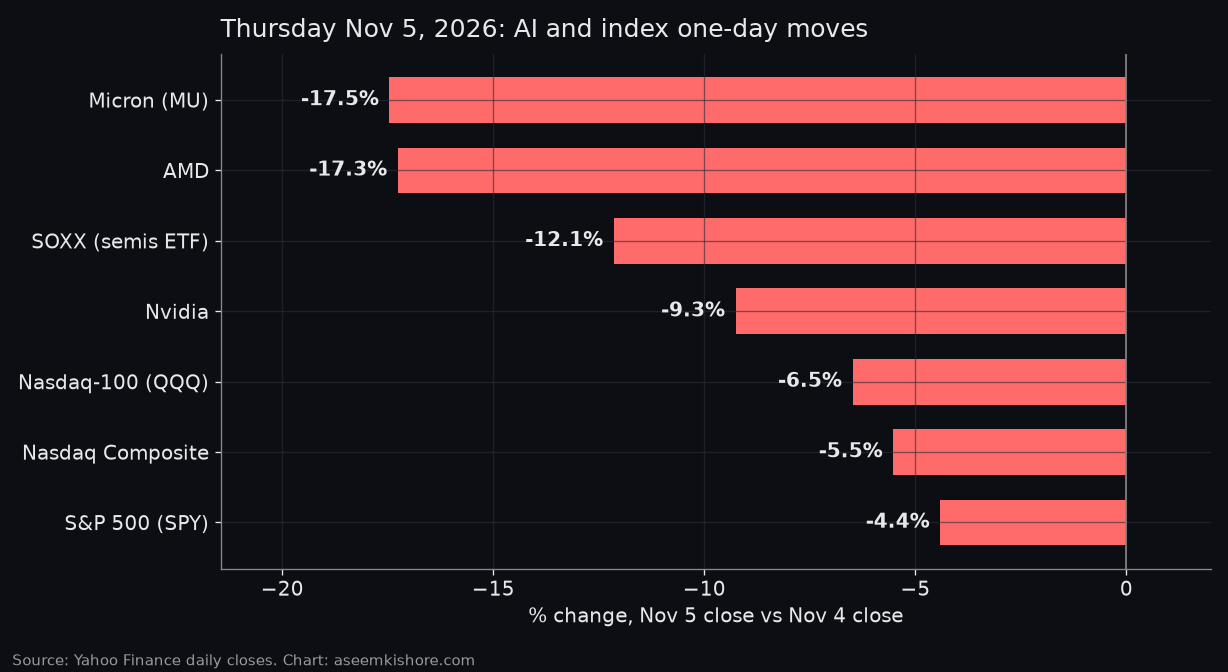
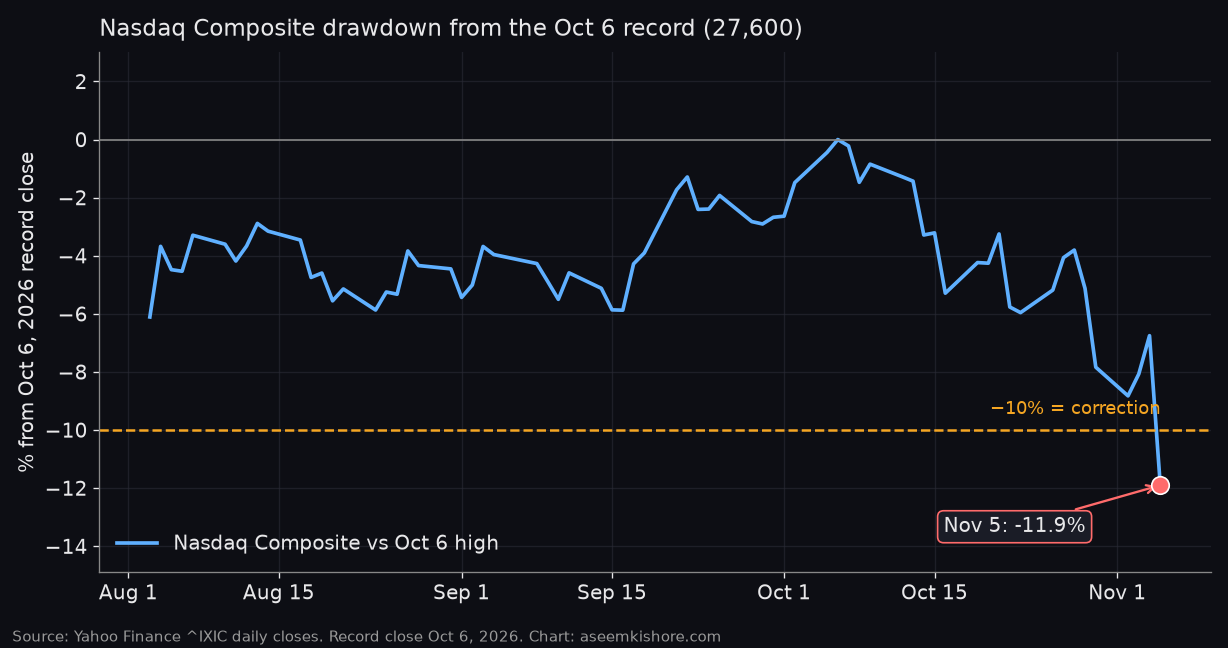
Thursday was one of those sessions that makes phones ring all afternoon. The Nasdaq Composite fell 5.5% and closed about 11.9% below its October 6 record, which puts the index in what Wall Street calls a correction. The S&P 500 lost 4.4% and the Dow fell about 1,830 points. Chipmakers led: Micron and AMD each dropped more than 17%, the SOXX semiconductor ETF lost about 12% and Nvidia fell more than 9% (CNBC, Yahoo Finance closes).
The midterm result was the spark. Investors reopened the question of whether a Democratic Congress plus state-level data center pushback will slow the AI buildout. I wrote about that Texas risk on Wednesday and I still think state permitting matters more than anything Congress is likely to pass. Thursday went further. It priced a sudden rethink of the whole AI spending story, not only Texas.
The VIX move is the cleaner signal
The Cboe Volatility Index closed at 28.18 after sitting at 16.61 on Wednesday, a one-day jump of about 70%. Brian Sozzi at Yahoo Finance, citing Cboe data, notes that a move this large has only happened eight times since 1991. After those prior spikes the S&P 500 was higher on average by 3.0% one month later, 7.1% at three months, 10.4% at six months and 14.7% at one year (Yahoo Finance / Brian Sozzi).
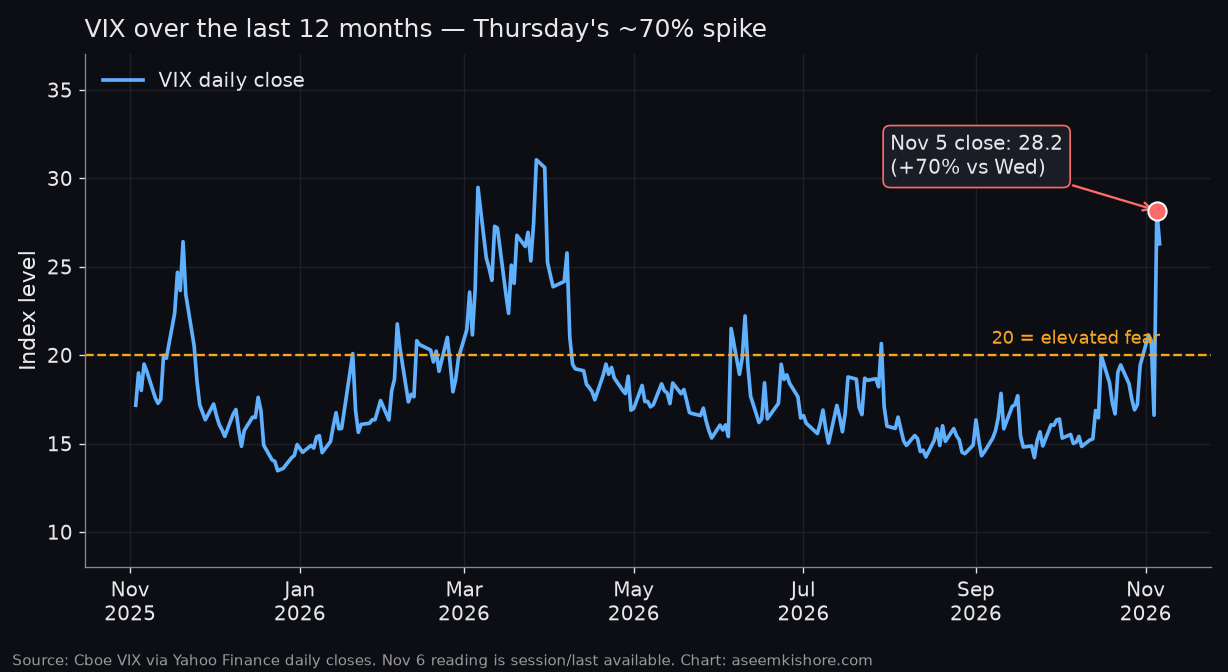
That history is a small sample and it does not promise a bounce next week. It does say extreme one-day fear spikes have usually been better moments to stay invested than to abandon a thesis. Reuters reported that hedge funds and retail both sold into the close, leveraged ETFs were set to dump tens of billions near the bell and put premiums ran about twice normal levels (Reuters). That is forced and panicked selling. Nothing in the filings said the chips stopped shipping.
The cash-flow doubt was already there
The political headline arrived on top of a shift that started in late October. After Q3 reports, Alphabet, Amazon and Meta all showed negative free cash flow while they guided to still-higher AI capital spending. Microsoft was the exception that still covered its bill from operations, with about $18.6 billion of free cash flow even as it spent roughly $45 billion (CNBC, TechCrunch). Markets had already started grading the group on cash, not only on cloud growth. Thursday compressed that worry into one session.
| Measure | Result |
|---|---|
| Nasdaq Composite | −5.5%; ~11.9% below Oct 6 high (correction) |
| S&P 500 | −4.4% (~$3 trillion of index market value) |
| VIX | 16.61 → 28.18 (~+70%); only 8 prior days this large since 1991 (Cboe via Sozzi) |
| Nvidia / AMD / Micron | about −9% / −17% / −17% |
| SOXX | about −12% |
Sources: CNBC, Yahoo Finance closes, Sozzi / Cboe.
My view
I am treating Thursday as a volatility event inside a buildout story that is still intact. Cloud demand and remaining performance obligations did not disappear overnight. What changed is the price investors will pay for companies that fund the next year of racks by burning cash or raising a lot of outside capital.
On any bounce I would rather own quality chipmakers and the largest hyperscalers that can keep spending without wrecking free cash flow than rotate into pure neocloud operators that need cheap funding and friendly permitting to work. I am not selling the AI infrastructure theme wholesale because Congress flipped. I wrote that on Wednesday and Thursday's tape did not change the permitting map. It did remind me that crowded trades unwind fast when the VIX doubles in a day.
My expectation is that the index recovers a meaningful share of Thursday's loss over the next few months if history after extreme VIX spikes is any guide and that the gap between cash-generative builders and cash-burning intermediaries keeps widening. I will keep watching who can pay for the next gigawatt without asking the market for a blank check.