Nvidia's board accepted Jensen Huang's resignation on Wednesday and the company announced it on Thursday. Huang had run Nvidia since he co-founded it in 1993. He left after a week of reports about his personal relationships, one of which has raised national security questions. CFO Colette Kress is now interim CEO and will keep the CFO job while the board searches for a permanent replacement. Harvey Jones, a director since 1993, became the company's first board chair, according to the 8-K filing.
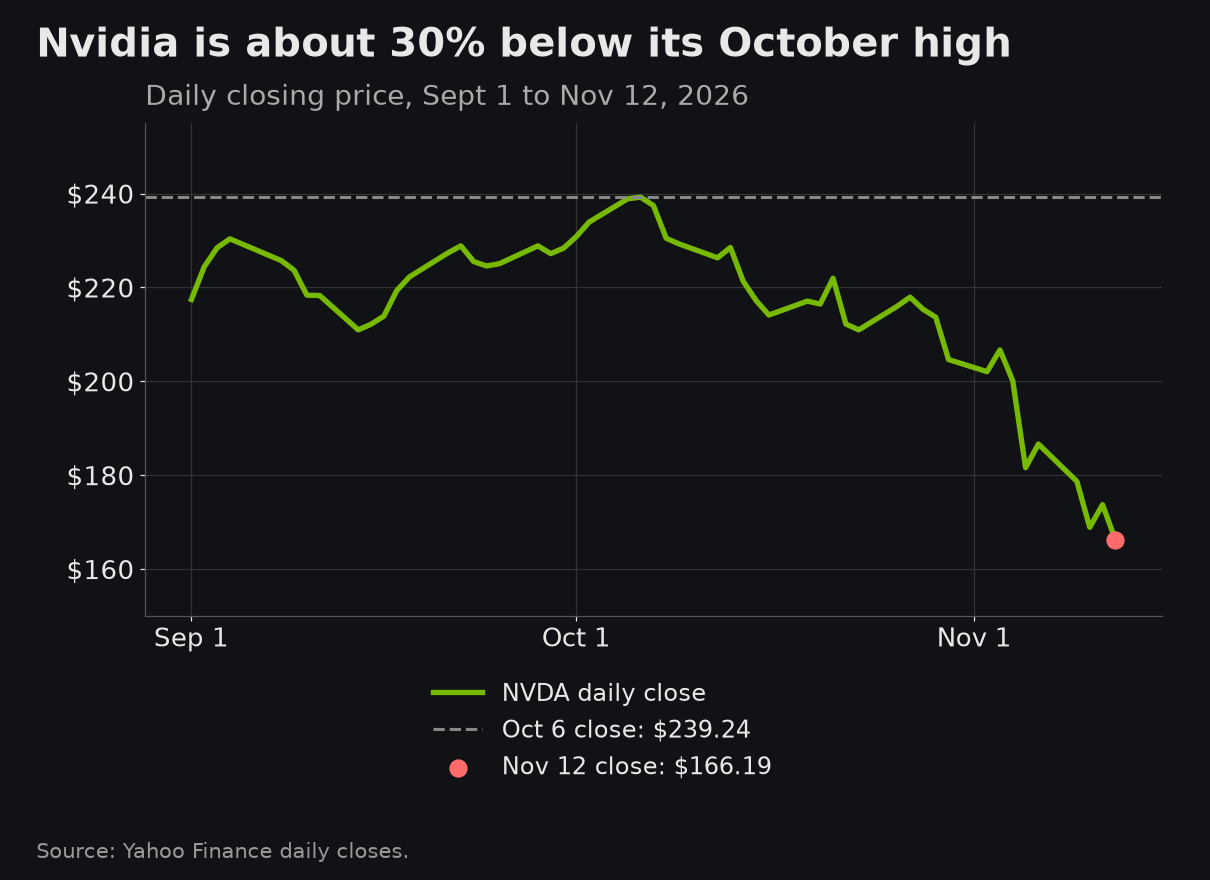
The stock closed at $166.19 on Thursday. That is down 4.3% on the day, 7% since Monday and about 30% below its October 6 close of $239.24, based on Yahoo Finance daily closes. Reuters gives the same 7% and 30% figures. Nvidia still reports third-quarter results on Tuesday, November 17.
Most of what I have read since Thursday asks whether Nvidia can keep shipping the best AI chips without its founder. I think it can for at least the next year or two. Chip roadmaps are set years in advance and the board said it expects the product roadmap and customer commitments to continue without interruption. The part of Nvidia that depended most on Huang personally is the deal-making. Over the past year Nvidia has become one of the largest financiers of the AI build-out and I expect that role to shrink under new leadership.
How much Nvidia has put behind its customers
The numbers in Nvidia's last 10-Q, for the quarter that ended July 26, are larger than I expected when I first read them.
| Item | Amount |
|---|---|
| Equity investments held | $99 billion |
| Equity investment commitments not yet funded | $25 billion |
| AI cloud agreements (capacity Nvidia commits to rent) | $36 billion |
| Data center leases it expects to pass to third parties | $20 billion |
| Data center guarantees, maximum exposure | $108.5 billion |
| Third-party capital targeted by financing memorandums | More than $500 billion |
Source: Nvidia Form 10-Q for the quarter ended July 26, 2026. Most of the guarantee figure is a single $105 billion guarantee tied to SB Energy.
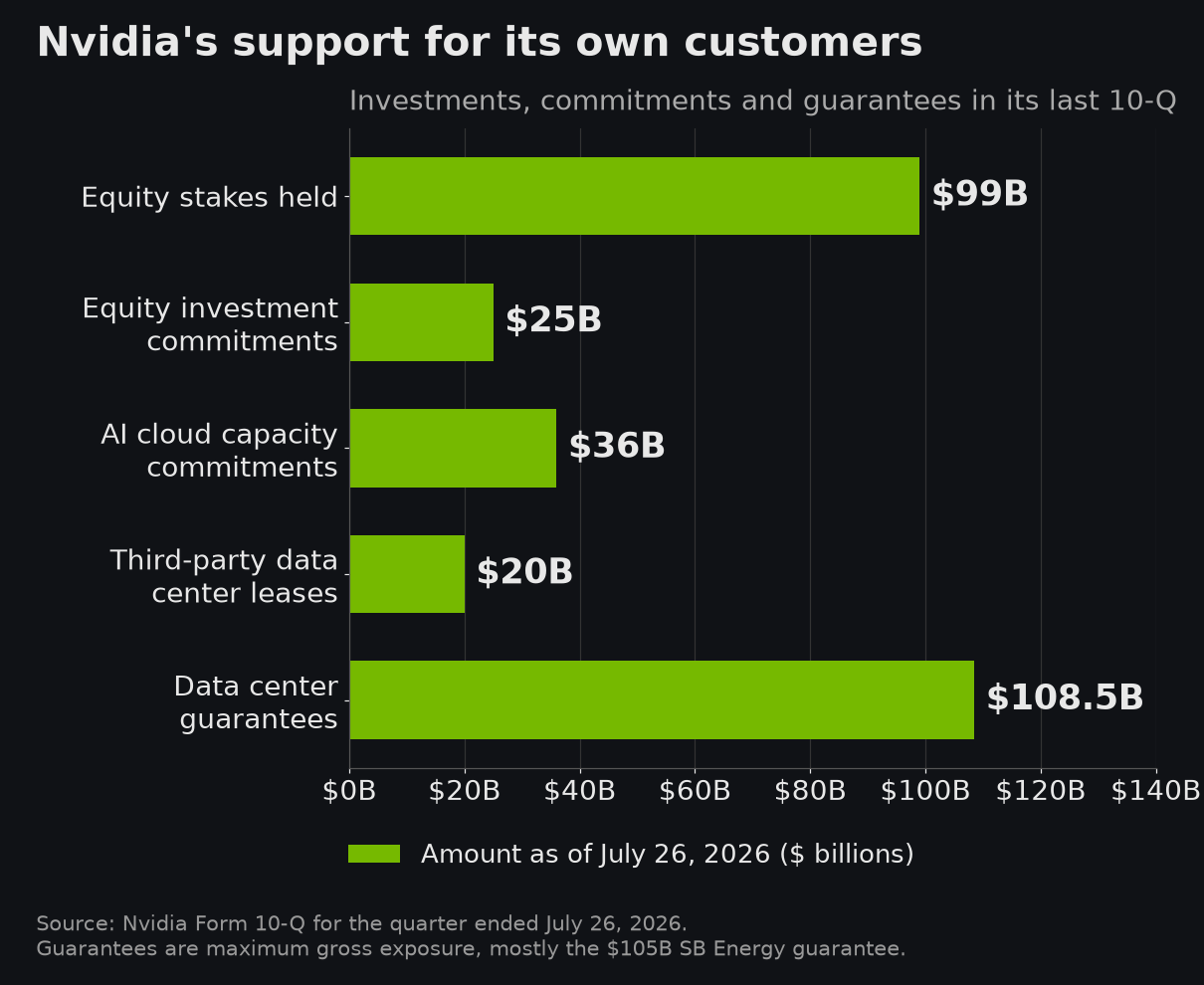
The AI cloud agreements matter most to me. Under them AI clouds buy Nvidia hardware and Nvidia commits to renting capacity back from them, which helps those clouds get their clusters financed. The filing also says Nvidia's private company stakes rose from $22.3 billion in January to $51.2 billion in July. The memorandums for more than $500 billion of outside capital are preliminary and the 10-Q says they may not lead to definitive agreements.
Why I expect this to slow
In the short term I don't expect much change. Kress has been CFO since 2013 and the AP describes her as an executive behind some of its biggest financing deals. The board chair called her a key architect of Nvidia's capital strategy. If anyone can keep these programs running through Tuesday's call and into next year, it is her.
The longer term is different. Analysts quoted by CNBC expect the permanent CEO to come from outside the company. Senator Tim Scott has asked Huang to testify before the Senate Banking Committee on December 3. A new CEO who inherits $108.5 billion of guarantees, Senate attention and a stock that has lost about 30% in five weeks has little reason to sign more of these deals. I would expect that person to finish the agreements already in place and be much slower to add new ones. I also expect fewer of the $500 billion in memorandums to turn into signed agreements.
The companies that would feel this first are the AI clouds that rely on Nvidia's backing. CoreWeave is a good example from this week. Its shares rallied midweek after strong third-quarter results and then fell back sharply on Thursday on the Huang news.
Why it matters to me
I pay for AI models every day to write code and run my sites. A lot of the capacity behind those models sits with AI clouds whose financing Nvidia helped arrange. If that support slows, I expect compute prices to stay high for longer and providers to keep tightening usage limits on the plans I use. I think this is a bigger issue for the AI industry than the question of who designs the next generation of chips.
On Tuesday I will look at the investment, AI cloud and guarantee lines in the new 10-Q and listen for whether Kress commits to the financing programs on the call. My expectation is that the AI cloud agreements line will be the first one to stop growing.