Last Thursday the security company Dragos published research by HD Moore that I think anyone running AI agents should read. From July through November his team sent about two million prompts to widely used AI services. Each prompt carried unique URLs and decoy credentials, including real AWS keys tied to empty accounts. If anyone used one of those secrets, someone had read the prompt that carried it. Moore wrote that "tokens started firing within days, and the tokens from July are still firing today."
I run AI agents on my publishing sites and on the small tools I've built around them. Those agents read config files, server logs and error output all day and some of that text contains keys. After reading the report I no longer assume that a prompt goes to one company, gets answered and is gone.
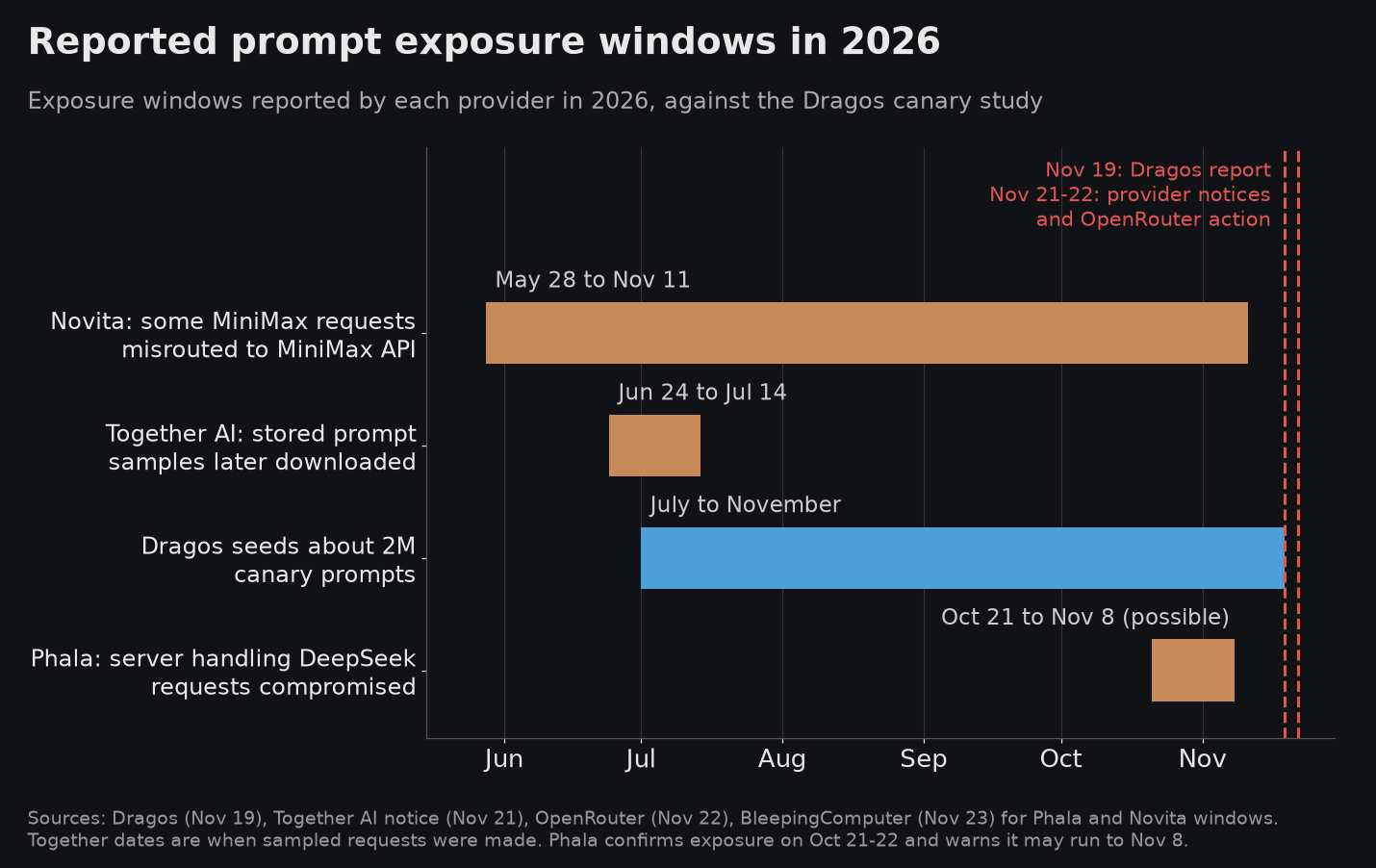
What Dragos found
The report describes three kinds of problems. Attackers were taking data from inside at least three hosting providers and none of the three knew until Dragos told them. Sellers on an inference marketplace could read and keep customer prompts with ordinary request logging. Several providers also appeared to ignore privacy settings. In two of the three breaches, some of the stolen requests were marked zero data retention, the setting that is supposed to stop a host from storing prompts. Moore's comment on that was "A privacy flag doesn't help when the attacker is already inside."
Dragos also says the systems of a Chinese AI lab fetched the secret links in roughly two-thirds of the requests to its models that were marked "no data collection" or zero data retention. That included prompts sent to U.S. hosts that resell the lab's models. In one case a secret link showed up in a company chat in China 24 days after the prompt went to a U.S. provider with the zero data retention flag set.
When attackers had the stolen AWS keys, they tested them, sometimes within a few hours. Then they listed storage buckets, searched secret stores and tried to create Bedrock API keys and their own IAM users. Dragos counted tens of thousands of AWS API calls made with the bait keys.
Who was affected
OpenRouter, which sends requests from a single API to many model hosts, said on Sunday that it had off-boarded three providers, removed 125 endpoints from zero data retention eligibility and notified every customer who may have been affected. It says the findings showed no breach of OpenRouter itself. OpenRouter didn't name the three providers in its post. BleepingComputer reports that they are Together AI, Phala and Novita.
| Provider | What it reported | Requests involved |
|---|---|---|
| Together AI | An AI coding agent committed a credential for a private Hugging Face repository to a public GitHub repository. An unauthorized party used it to download stored prompt samples and tested credentials found in them. | Samples from MiniMax M3, GLM-5.2 and Kimi K2.6 requests, mainly from June 24, July 4, July 8 and July 14 |
| Phala | An attacker compromised a server processing DeepSeek V4 Flash 0731 requests routed through OpenRouter and obtained application credentials. | October 21 and 22, possibly up to November 8 |
| Novita | A routing misconfiguration sent some MiniMax requests, including OpenRouter traffic, to MiniMax's own API. | May 28 to November 11 |
Sources: Together AI notice of November 21 and BleepingComputer for the Phala and Novita reports.
The Together AI case is the closest to my own work. The company says it stored prompt samples for routine testing in a private repository. While an AI coding agent was working on a public repository called xorl, it committed a credential for that private store. Together's scanning caught it and the commit was reverted. By then someone had already taken the credential. That person downloaded the samples and searched them for other credentials to test. Five of those were Dragos canaries. I give coding agents access to my repositories and environment files in a similar way, so the same thing could happen in my own repositories.
What I'm changing
I'm treating zero data retention as a statement of a provider's policy. It only helps if the provider follows it and nobody has broken into their systems. With that in mind I'm making a few changes.
- Keys and passwords should not appear in anything an agent sends to a model. I'm scrubbing logs and config output before an agent reads them and giving agents scoped credentials where the service supports it.
- Any key that has ever been in a prompt gets rotated. I'm assuming it has been read.
- Work that touches client sites goes to the lab that makes the model or to a host I have an agreement with. The cheapest seller for a model is not where I'd send it.
- I'm going to put a few canary tokens in my own agent prompts. Dragos started its study with Thinkst Canarytokens and the same approach works at a small scale.
Where I think this goes
OpenAI's updated usage policies took effect on Friday. They require model routers and AI gateways to get OpenAI's review and approval before offering direct access to its models, according to OpenAI's October announcement and Semafor. That rule was announced a month before the Dragos report, so I don't read it as a response. The two still point the same way. I expect routers to drop many of the small hosts, require audits before they restore privacy labels and charge more for routing they can verify. OpenRouter already says it will run checks like the Dragos tests on an ongoing basis and require validation before any of the 125 endpoints gets zero data retention back.
I also expect the lowest prices for open models to go up over the next year, because that checking costs money. Dragos describes how a seller can list a popular model at the lowest price, take the traffic, pay the difference and collect the prompts from its logs. After reading that, I see a price well below everyone else's as a reason to ask where my prompts are going. I would rather pay somewhat more per token for a host I can account for.