I stayed up for the midterm results last night and watched stock futures react as the numbers came in. Nasdaq-100 futures fell as much as 2.4% and S&P 500 futures fell as much as 1.4% once it became clear that Democrats would win both the House and the Senate (Reuters). By this morning most of that had reversed. At 8:31 a.m. Eastern the SPY ETF was trading about 0.9% above Tuesday's close and the small-cap IWM fund was up 1.5%.
The result is a divided government. President Trump keeps his veto, so Democrats will need his signature for anything they want to pass once the new Congress meets in January. Markets have usually been comfortable with that arrangement because very little new legislation gets through. ING's analysts made a related point this morning when they said the early selling reversed partly because Democrats do not take office until January (Investing.com).
What history says about the year after a midterm
I checked the record before writing this. In each of the 19 midterm elections from 1950 through 2022, the S&P 500 was higher 12 months later. The average gain was 15.1% and the weakest result was the year after 1986, when the index rose 1.1% (Pepperstone, Yardeni Research). Which party wins has not made much difference. One breakdown found an average 12-month gain of 15.1% after the 14 midterms that produced divided government and 15.0% after the five that left one party in full control (SimianX).
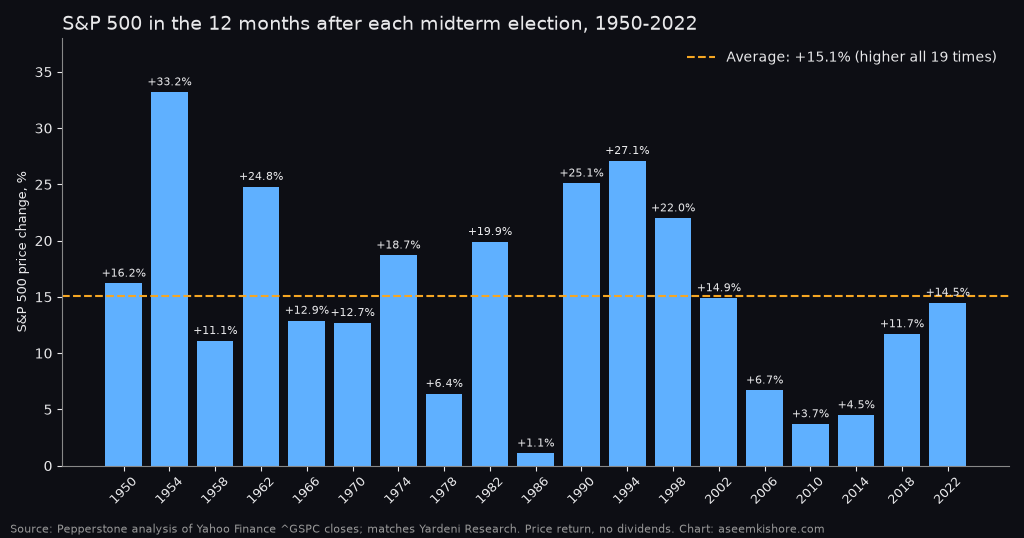
I don't treat this as a guarantee. Nineteen elections is a small sample and the path was often rough. In 11 of those 19 years the index fell more than 10% from a peak at some point during the following 12 months, according to Pepperstone. This cycle also starts with higher borrowing costs than most of them. The 10-year Treasury yield closed at 4.95% on Tuesday (MarketWatch) and Brent crude settled at $103.60 a barrel with the Iran conflict still unresolved (CNBC).
Where the selling showed up
The more useful information this morning is in which stocks moved. Solar companies rose sharply. The companies that build and rent out data centers fell, along with defense contractors and Tesla. Microsoft, Alphabet and Meta were trading higher.
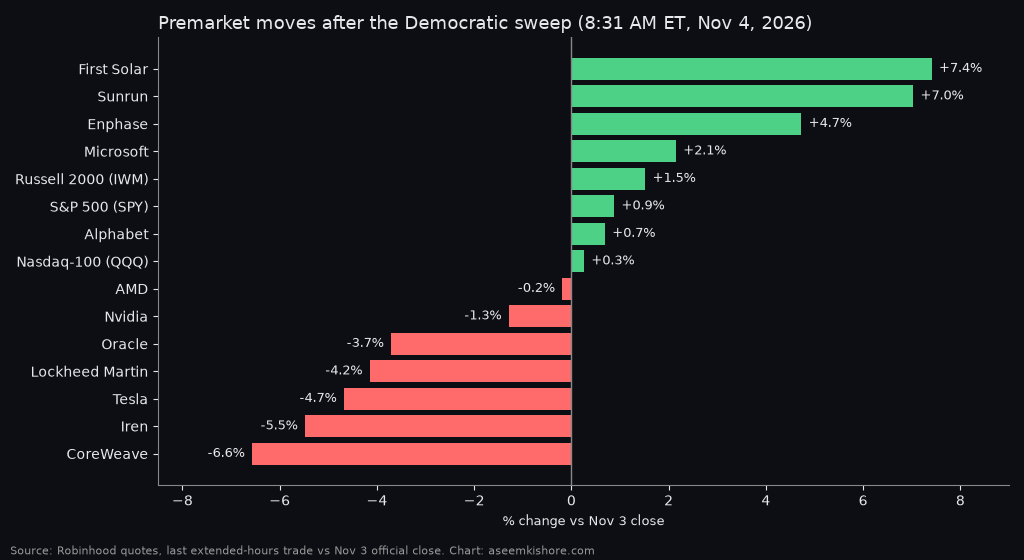
Most of the split comes from Texas. Democrat Gina Hinojosa defeated Governor Greg Abbott after campaigning for an immediate moratorium on data centers in the state. Wells Fargo estimates that 27% of planned U.S. data center gigawatts are in Texas. Its chief equity strategist, Ohsung Kwon, had written before the vote that a Democratic win there could be a "left-tail event" for the AI trade. Dan Ives of Yorkville Ives called Texas the "biggest worry" of the night for tech investors (CNBC). Reuters reported that analysts doubt Congress could pass anything that meaningfully stalls data center construction, though more hearings and investigations are likely (Reuters).
My view
I am not selling because of this election. A divided Congress facing a presidential veto is unlikely to pass a federal law that slows the AI buildout in a serious way. Hearings will produce headlines and probably some volatility. AMD's report last night also showed that spending on AI chips is still growing. Its data center revenue rose 97% to a record $8.5 billion and it guided to about $17 billion of fourth-quarter revenue, compared with the $16.23 billion analysts expected (AMD, Reuters). The stock jumped to $520.40 after hours (Investing.com). By 8:31 this morning it was trading slightly below Tuesday's close, which tells me investors are still nervous about the group as a whole.
State permitting is a different kind of risk. A governor can delay projects and a moratorium in Texas would fall hardest on the companies that own the buildings and have signed the land and power deals. That group includes neocloud operators such as CoreWeave and Iren and developers such as Applied Digital and Core Scientific. I expect chip designers and the largest cloud companies to send more of their future projects to other states if Texas becomes difficult. The operators with sites already under way in Texas have fewer choices.
My expectation is that the S&P 500 will be higher a year from now, in line with the historical pattern, and that data center operators will trail the chipmakers and the large cloud companies over that period. The policy I will follow most closely is what Texas does in its first legislative session under Hinojosa. Elon Musk posted overnight that "data centers in space" are looking appealing. For companies that have already poured concrete in Texas, that is not a realistic plan.