I read OpenAI's research post from November 4 on its autonomous cyber pipeline. In one mid-October run the system analyzed 2,308 candidate findings in the Linux kernel, dynamically reproduced 1,724 of them and produced 948 working local privilege-escalation exploits plus 291 information-leak proofs of concept. The run cost $1,213,430 in API credits, or $1,279 per LPE. The target was a stock desktop operating system under the same threat model used by competitions such as Pwn2Own.
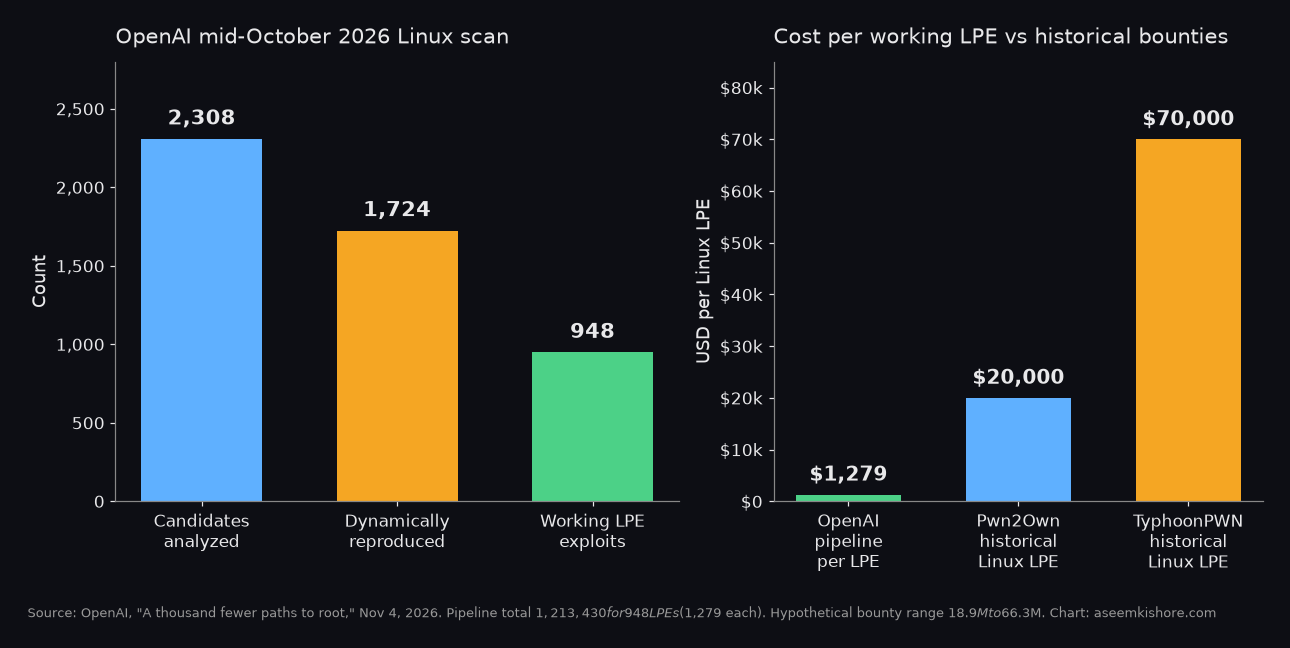
What the cost comparison shows
OpenAI applied historical Pwn2Own ($20,000) and TyphoonPWN ($70,000) Linux LPE bounty amounts to those 948 exploits and got a hypothetical valuation of $18.9 million to $66.3 million. That is roughly 16x to 55x the pipeline cost. On an adapted kernelCTF environment the same pipeline found 25 information-leak PoCs and 21 LPEs for about $32,936. If those 21 were accepted the bounty would be around $1.5 million, or about 45x the scan cost.
| Run | Model | Working LPEs | API cost | Notes |
|---|---|---|---|---|
| June 2026 | GPT-5.5 Cyber | 24 | not stated as a full campaign total | Patch the Planet reports |
| July 2026 | GPT-5.6 Sol | 166 | $513,690 | Latest kernel at the time |
| Mid-October 2026 | Upcoming cyber model | 948 | $1,213,430 | $1,279 per LPE; also 291 info-leak PoCs |
| kernelCTF adapted | Same pipeline | 21 | ~$32,936 | Plus 25 info-leak PoCs; ~45x if accepted |
Sources: OpenAI, "A thousand fewer paths to root". The October run produced more than five times as many novel LPEs as the July run despite three months of hardening between the scans. OpenAI also says that to the best of its knowledge the agents used at least 10 novel Linux exploitation techniques.
Maintainers are already racing
The Linux community is not standing still. Within 10 days while the scan ran, OpenAI observed more than 100 Linux LPEs patched or in staging from other contributors, with about 300 more being discussed publicly. By the end of its analysis, 61 of the identified LPEs had already been patched upstream, 43 had staging patches and 299 were being reported or discussed. That helps users who keep systems current and it also shows how much work triage and review now create.
OpenAI is clear about the limits. The work ran in a controlled research environment. The exploits require an existing foothold on the machine. The candidate patches still need expert review before they go upstream. Those caveats matter and they do not change the direction of the economics.
My view
For most of the industry's history, finding a serious Linux kernel privilege-escalation bug was something a small number of skilled researchers did one investigation at a time. That scarcity is what made $20,000 to $70,000 bounties look reasonable. A pipeline that delivers a working exploit for about $1,300 turns discovery into an operations problem. Teams can now surface more working exploits than they can carefully triage and patch.
My expectation is that within a couple of years every serious product and infrastructure team will run continuous agent hunters against its own stack the way teams already run continuous integration. Waiting for a contest or a bounty submission will feel late. Bug-bounty programs will still have a role for outside researchers and for cases AI misses, but the headline payouts for Linux LPEs look outdated next to the cost OpenAI just published.
I also expect the next hard problem to be the same one OpenAI ran into: too many real findings and not enough human review capacity. Automated patch generation with expert oversight is the path that keeps up. Teams that treat vulnerability discovery as a scarce craft will fall behind teams that treat it as a pipeline they own.