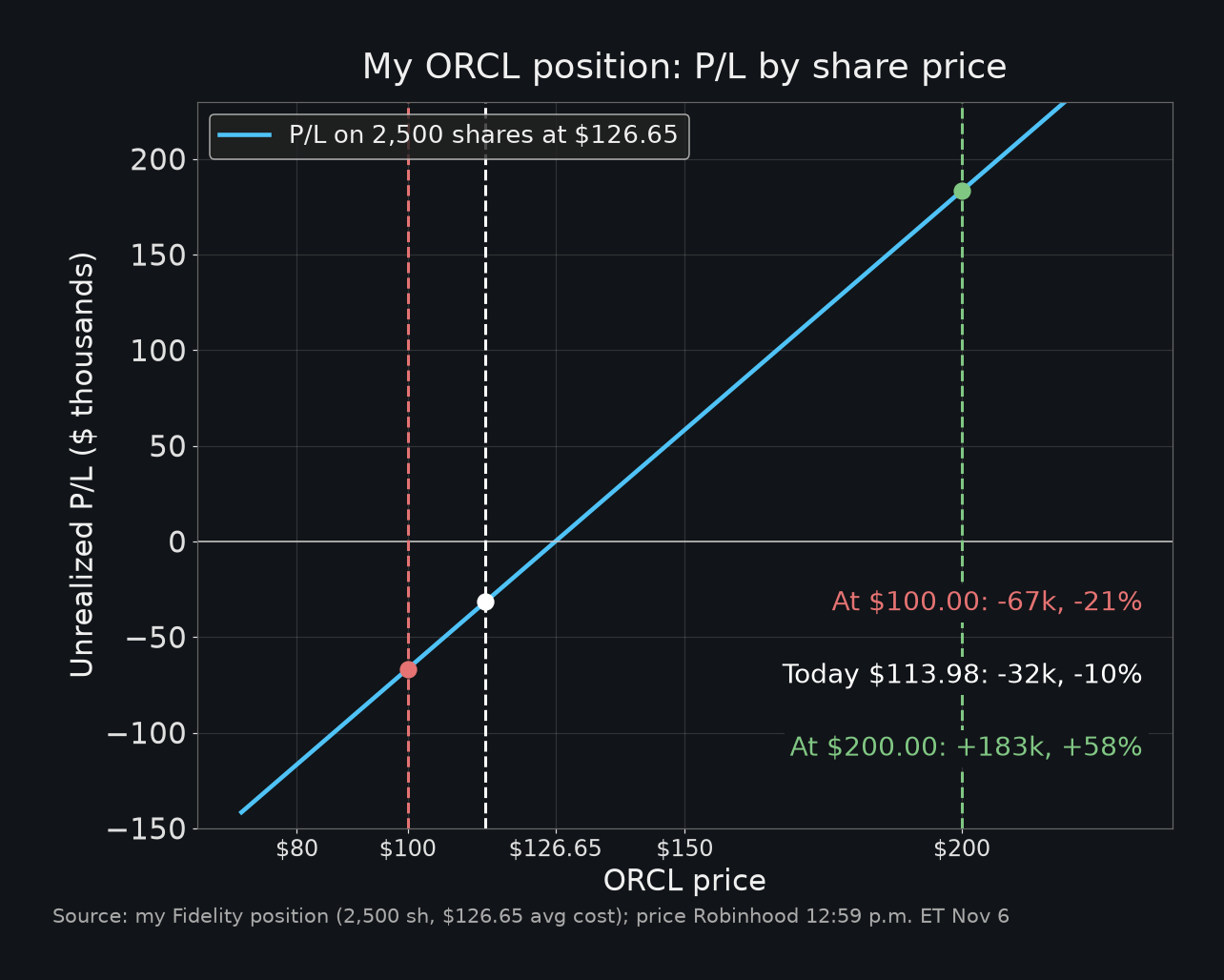
Disclosure: I own 2,500 shares of Oracle in Fidelity at an average cost of $126.65. I bought 500 of those on November 2 after the stock sale was announced. I have no open Oracle options. At today's price the position is down about $32,000, or roughly 10% below my cost. Keep that in mind as you read this.
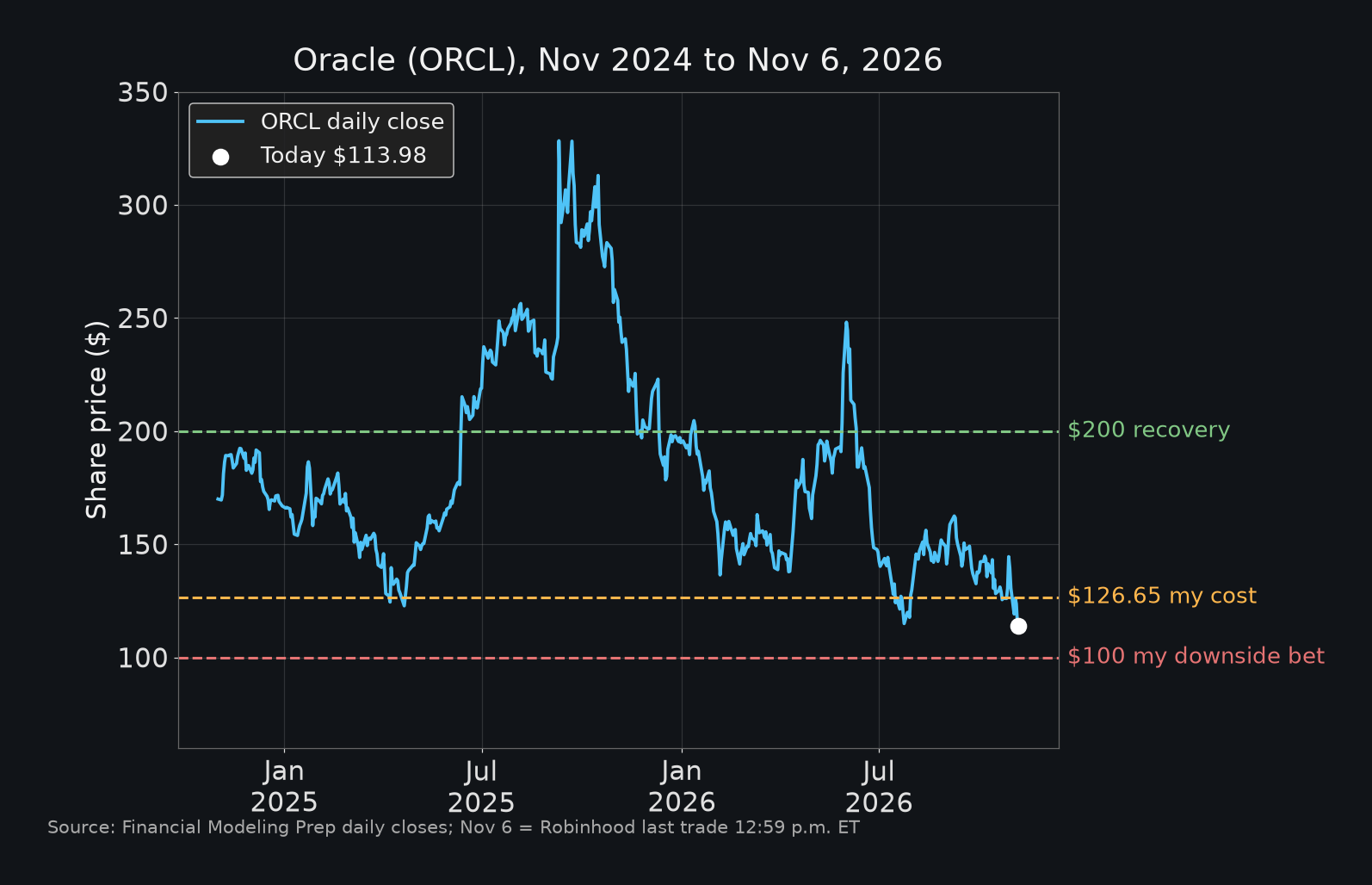
Oracle traded at $113.98 at 12:59 p.m. ET today, down about 1% from Thursday's close of $115.16 (Robinhood quote). That is a small move on its own, but it comes after the worst stretch the stock has had in decades. It peaked at a $328.33 close on September 10, 2025, so it is now about 65% off the high. It is down roughly a third this year.
My bet
I think the stock can still fall under $100. If it does I'm going to buy more shares. At $100 my 2,500 shares would be down about $66,600, or 21% from my cost. I'm fine with that because I don't see Oracle as a company that is going to fail. My guess is that it takes a year or two to get back above $200. I think that will happen and at these prices I see this as a chance of a lifetime to add. Below is why I believe that and what could prove me wrong.
Why it fell
At its October 28 investor day Oracle set a fiscal 2030 revenue target of at least $225 billion and said it would cap new capital-markets funding at $20 billion through fiscal 2030. The stock jumped about 11%. Then on November 2 it raised the whole $20 billion in one day: 86.2 million shares at $116, an 11% discount to the prior close, plus $10 billion of notes at 7% to 8.65% (CNBC, Yahoo Finance). Shares fell 8.8% that day. Over three sessions the drop was close to 18%, the worst three-day stretch since 2002 by Yahoo Finance's count. The AI selloff that followed Amazon's results and Thursday's broader rout added to it.
The fundraising was what they had promised. The market's issue is the price. Selling stock at 14 times forward earnings and borrowing at up to 8.65% tells you the cost of capital has gone up for Oracle.
The numbers
The business is growing faster than it has in years. First-quarter fiscal 2027 revenue (quarter ended August 31) was $19.35 billion, up 30%. Cloud infrastructure revenue more than doubled to $7.4 billion. Oracle guided to at least $90 billion of revenue for fiscal 2027 (Oracle Q1 release).
The backlog is the reason I'm still in. Remaining performance obligations were $664 billion, up $209 billion from a year ago. That is signed contract value, not a forecast. Management said about half should turn into revenue over the next 36 months (Q1 call transcript). A large share of it is AI training capacity for a few very big customers. That concentration is a risk if one of them pulls back.
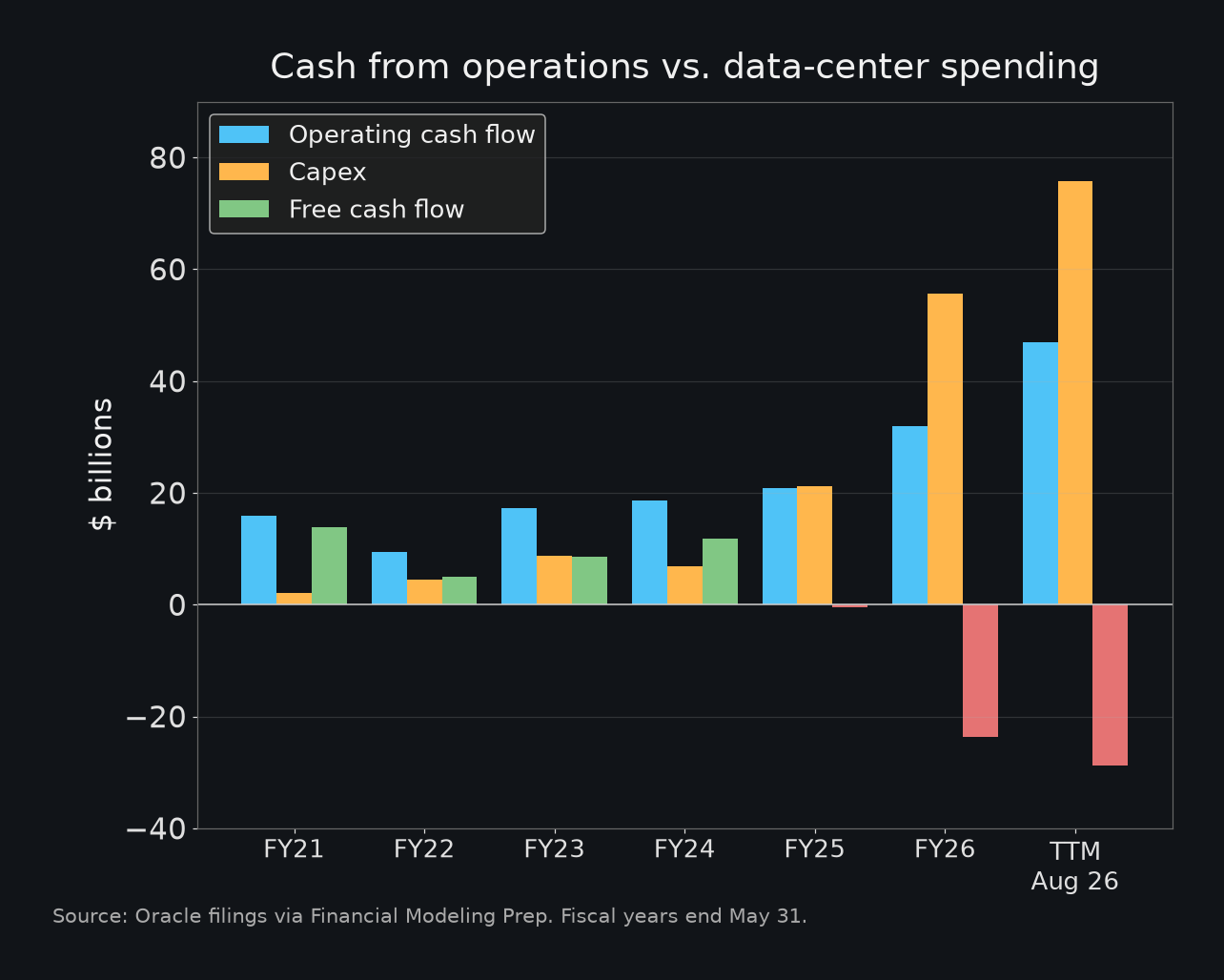
Cash flow is where the bear case lives. Operating cash flow is strong but capex is much larger. Fiscal 2026 free cash flow was negative $23.7 billion. Over the last four quarters it was about negative $28.7 billion. Oracle expects $90 to $95 billion of capex this fiscal year and says free cash flow turns positive in the second half of 2028, with at least $30 billion in fiscal 2029 (TipRanks).
| Metric | Figure |
|---|---|
| Q1 FY27 revenue (Aug 31, 2026) | $19.35B, up 30% |
| Trailing 12-month revenue | $71.8B |
| Q1 cloud infrastructure revenue | $7.4B, up 121% |
| Remaining performance obligations | $664B, about half expected within 36 months |
| FY26 operating cash flow / capex | $32.0B / $55.7B |
| FY26 free cash flow | -$23.7B |
| Q1 FY27 free cash flow | -$5.4B |
| Total debt incl. leases (Aug 31) | $155.9B; borrowings $125.3B |
| Cash and investments (Aug 31) | $37.1B |
| Interest expense, trailing 12 months | $5.1B, about 4.6x covered by operating income |
| Credit ratings | S&P BBB-, Fitch BBB, Moody's negative outlook |
Can it go bankrupt?
I don't think so, but I want to be fair about the risks. Oracle earned $23.2 billion of operating income over the last four quarters. Its software and database business still throws off cash and its customers rarely leave. Interest is covered more than four times. That is not a company near default.
The debt load is real though. Borrowings of about $125 billion as of August were nearly twice shareholders' equity before the new $10 billion of notes. S&P cut Oracle to BBB-, one notch above junk, in July. Credit default swaps trade at levels CNBC described as closer to a high-end junk rating. The realistic risks are more dilution, more expensive debt, a downgrade, slower profits on the AI data centers or a big customer delaying commitments. Any of those could keep the stock down for a long time without Oracle ever being in danger of failing.
Valuation and scenarios
With roughly 3.1 billion shares after the offering, the market value near $114 is about $350 billion. That is around 4.9 times trailing revenue and about 14 times forward earnings against a five-year average near 21 (Yahoo Finance). The average analyst target is in the $235 to $244 range. I don't lean on targets much since they were higher before the stock fell 65%.
| Scenario | What happens | My P/L vs $126.65 |
|---|---|---|
| Drop under $100 | AI selloff deepens, a downgrade or a customer delay. I buy more. | -21% at $100, -37% at $80 |
| Chop between $100 and $140 | Capex peaks and cash flow stays negative into 2028 | -21% to +11% |
| Back above $200 in 1 to 2 years | Backlog converts to revenue on schedule and free cash flow turns positive | +58% or more |
My prediction
I expect the stock to trade under $100 at some point in the next few months. The path back to $200 depends on two things I can watch each quarter: cloud infrastructure growth staying above 100% and capex falling relative to operating cash flow. If Oracle hits positive free cash flow in the second half of 2028 as promised, I think $200 is reachable by late 2027 or 2028. If that date slips, two years could easily become three. I'm holding my 2,500 shares and I plan to add below $100.