Google released Gemini 4 Neon on Wednesday and I moved my coding work to it the same day. I've used Google's models for most of my coding this fall, first Argon and then Carbon. I still use Claude Opus as well. In my own use Neon is the best of them. The benchmark results came out about where my experience did, but the number I care about most is the cost of finishing a task.
What the independent numbers show
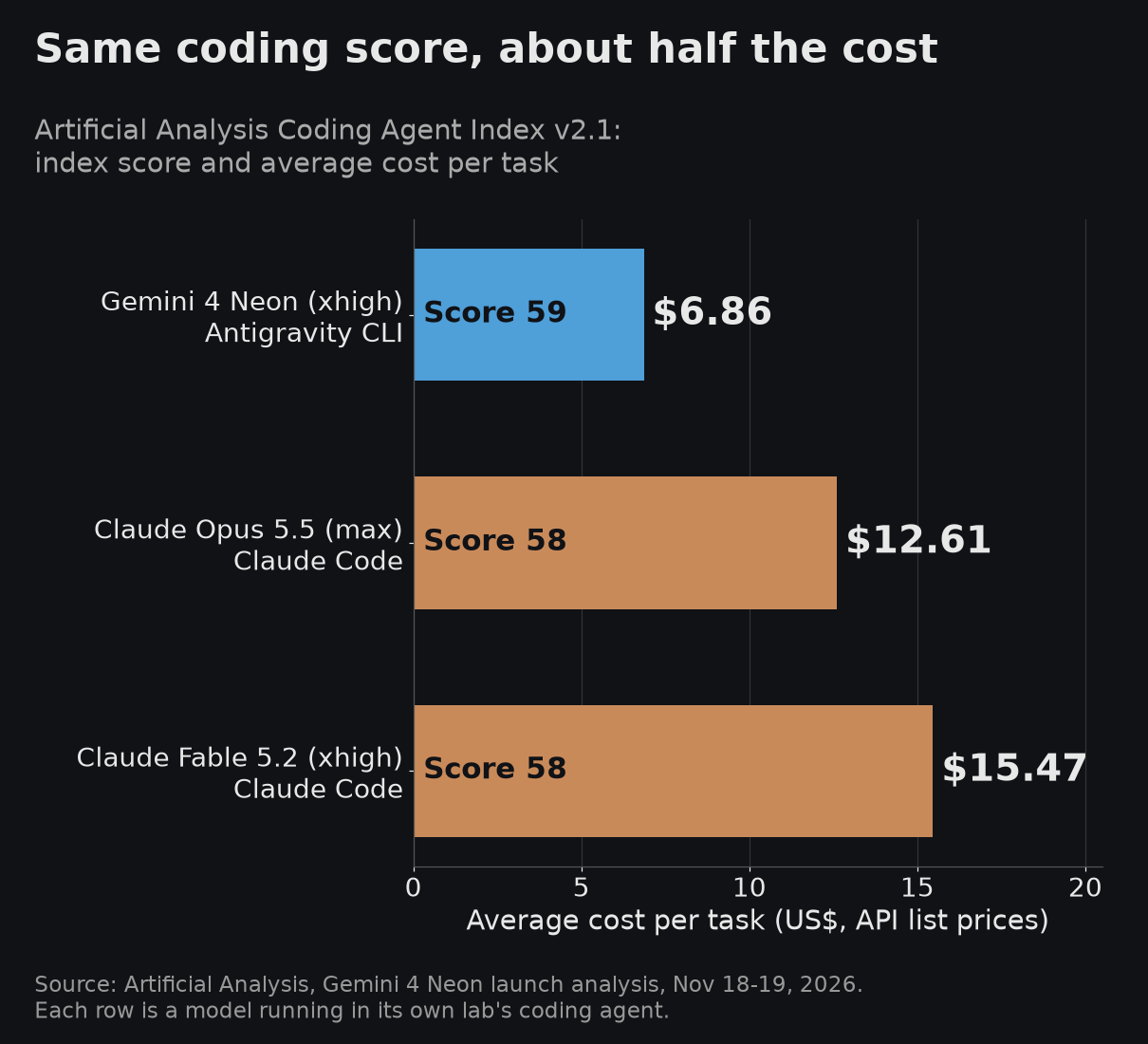
Artificial Analysis runs each model inside its own lab's coding agent and scores it on 322 tasks covering code changes, terminal work and questions about a repository. On version 2.1 of that index, Neon at its xhigh setting in Google's Antigravity CLI scored 59. Claude Opus 5.5 at max and Claude Fable 5.2 at xhigh, both in Claude Code, scored 58. Google's announcement gives Neon's unrounded score as 58.6 and Indie Hackers reports Opus 5.5 at 58.2. A gap that small is a tie in my view.
The cost gap is much larger. Artificial Analysis puts Neon's average cost per task at $6.86, compared with $12.61 for Opus 5.5 and $15.47 for Fable 5.2. Those figures use API list prices. Neon costs $3 per million input tokens and $15 per million output tokens, which VentureBeat notes is 25% below Opus 5.5's standard $4 and $20.
One detail in the Artificial Analysis write-up is worth knowing before anyone calls Neon efficient. On its broader Intelligence Index, Neon used about 15% more output tokens per task than Gemini 4 Carbon. Its lower cost comes from lower token prices and its shorter time per task (about 21 minutes against about 36 for Carbon) comes from faster output. Neon is cheaper per token and it also writes more.
Why cost per task matters more to me than rank
I run coding agents for much of the day on my publishing sites and the small internal tools I've built around them. Most of that work is ordinary, such as fixing a page template or repairing a script that broke after an update. For that kind of work a one-point difference on an index doesn't change my results. What changes my results is how many tasks I can finish before I hit a limit.
On a subscription I don't see a per-task bill. I see usage limits. With Opus I usually reach mine within one or two days of a reset. Google's models have given me far more room and Neon has continued that so far. I don't know how each company sets its plan limits, but a model that costs about half as much to run per finished task gives its provider more room to be generous. That is the practical reason I switched.
Cursor's new unified plan shares usage with Grok
Cursor is now sold as part of The X Subscription, which combines Cursor, Grok and X on one plan. xAI announced it in October and TechCrunch reported the same structure. The pricing pages at x.ai and Cursor list four paid tiers: Plus at $8 a month, Premium at $30, Super at $100 and Ultra at $200. Every paid tier includes one weekly pool of usage for Grok models, shared across Cursor and the Grok apps, including chat, voice and image generation. On Premium and above that pool also covers Grok Bot and video generation. Cursor's usage docs say the allowance refreshes weekly and unused usage does not roll over. Third-party models in Cursor are not in the pool. On Premium and above they are billed separately at API list prices from the first use.
I don't like the shared pool much. In my own use Grok now draws from the same allowance as my coding work and it runs out fairly quickly, much faster than when the products were on separate plans. Grok can eat usage very quickly. Claude Pro is $20 a month or $17 a month if you pay $200 for the year. Claude Max is $100 a month and Claude Ultra is $200 a month. ChatGPT Plus, which includes Codex, is $20 a month and ChatGPT Pro is $100, $200 or $500 a month. Google AI Pro is $19.99 a month and Google AI Ultra is $99.99 or $199.99 a month, depending on the usage tier. Those plans have limits too. The difference for me is that heavy use of Grok chat, image and video tools or of Grok Bot now uses up the same weekly pool I need for coding. When the plans were separate, that did not happen. I feel I'm getting less for my money on the unified plan than I do with Claude, Codex and Gemini.
| Model and effort | Coding agent | Index score | FrontierCode-AA 2.0 | Average cost per task |
|---|---|---|---|---|
| Gemini 4 Neon (xhigh) | Antigravity CLI | 59 | 43 | $6.86 |
| Claude Opus 5.5 (max) | Claude Code | 58 | 44 | $12.61 |
| Claude Fable 5.2 (xhigh) | Claude Code | 58 | 49 | $15.47 |
Sources: Artificial Analysis for scores and costs. FrontierCode subscores as read from Artificial Analysis's launch chart by Tabbit.
Where I would be careful
The Claude models still lead on the code-modification part of the index. Fable 5.2 scored 49 on FrontierCode-AA 2.0 against 43 for Neon. If most of my work were large changes to unfamiliar code, I would weigh that more heavily than I do.
Prices are also moving under these comparisons. Carbon's discounted price of $2 and $10 ends on November 30 and goes to $4 and $20 on December 1, according to Artificial Analysis and VentureBeat. Microsoft launched MAI Code 2 on Tuesday and says it delivers 96% of Opus 5.5's performance at 5% of the cost, but its own footnote says that cost is measured at a 50% promotional price. InfoWorld reports the promotion runs until May 17, 2027. Any cost comparison I read now needs the date of the prices it used.
There is also the question of what a task costs after the model is done. An analyst quoted by InfoWorld said enterprises should judge coding models on the total cost of successfully completing a task and not on benchmark scores. I agree with that and for my own work it means counting retries and the time I spend reviewing a change before I merge it. A task I have to redo costs more than its first run suggests.
What I expect next
Google has now released four Gemini models in seven weeks, by Artificial Analysis's count. I expect the next few months of competition between the labs to be fought on price per finished task and on subscription limits more than on index rank, because the top scores are now this close. I also expect Anthropic to respond on pricing or usage limits before it responds with a higher score. I'll keep using Neon until another model finishes my work for less. I plan to judge that by the changes I actually merge in my own repositories.