I spent last week reading the Big Tech earnings calls and I found the comments on spending more interesting than the revenue numbers. Microsoft CFO Amy Hood said capital spending came in lower than planned "as some third-party capacity deliveries we expected in Q1 were delayed." In other words, Microsoft intended to spend more than it did. I think that says a lot about where AI is at the moment.
Amazon, Alphabet, Microsoft and Meta spent roughly $209 billion on capital projects in the July to September quarter. If you add up their own guidance for 2026, the total for the year is about $730 billion. That is more than double what the same four companies were guiding to for 2025, according to the math from GridTilt. Each company defines capital spending a little differently, so these totals are approximate.
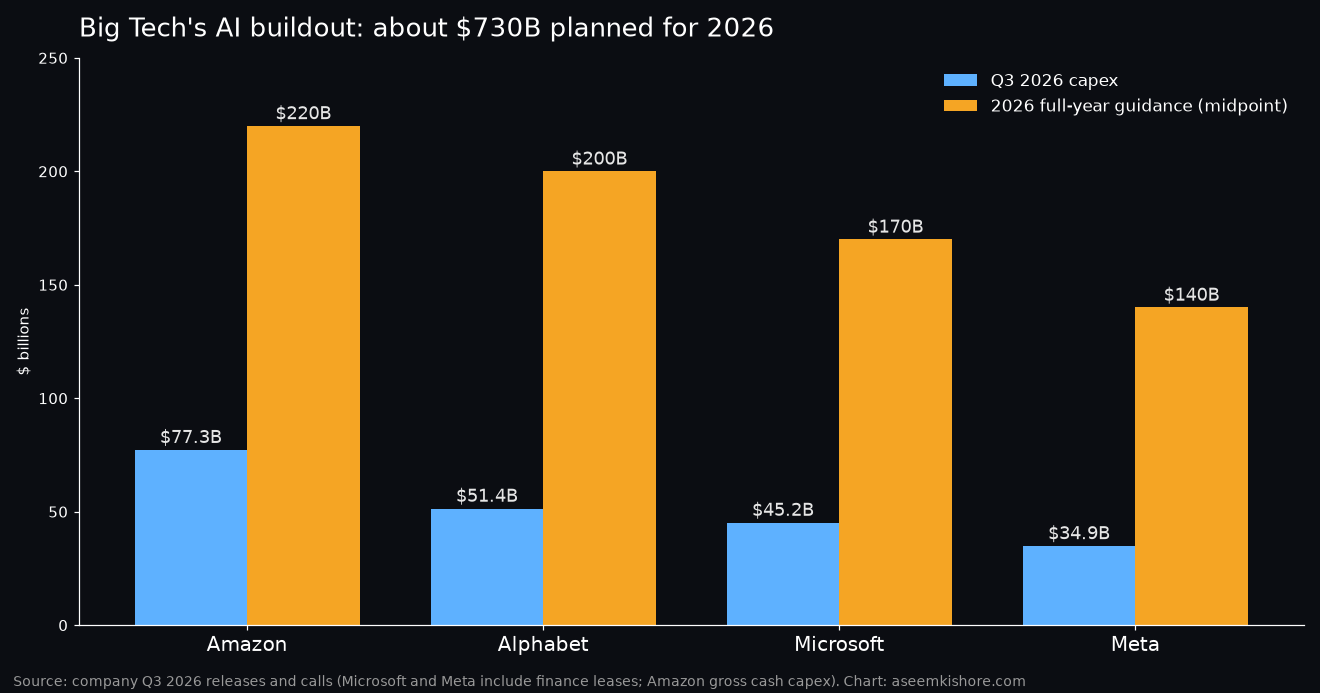
The limit is capacity
All four companies described demand as strong. Azure grew 48% and Hood said "we still have demand that exceeds supply." Google Cloud revenue grew 103%. Alphabet also started renting compute from outside providers at the end of the quarter because it could not build its own quickly enough. Andy Jassy said inference already accounts for "well over half" of AWS's AI revenue. He also said he doesn't expect the shortage of data center space, power and memory to end in 2027 (The Deep Feed, Yahoo Finance).
The backlogs these companies are reporting support this. Microsoft's commercial remaining performance obligation is $677 billion. AWS reported $578 billion and Google Cloud reported $561 billion. Each of those is larger than a full year of the spending that investors are concerned about.
How investors responded
| Company | Q3 capex | Q3 free cash flow | Cloud growth | Stock on report day |
|---|---|---|---|---|
| Microsoft | $45.2B | +$18.6B | Azure +48% | -0.2% |
| Alphabet | $51.4B | -$9.1B | Cloud +103% | -12.6% |
| Meta | $34.9B | -$2.1B | n/a | -7.0% |
| Amazon | $77.3B | -$7.6B | AWS +39% | -1.4% |
Sources: CNBC, Averin, Yahoo Finance. Microsoft and Meta capex include finance leases.
Alphabet is the clearest example. Its cloud revenue more than doubled, yet the stock fell almost 13% on the day of the report because free cash flow turned negative. Microsoft still generates enough cash to cover its spending and its stock was close to flat. Even so, Microsoft's free cash flow declined 27% and the company said it will borrow in the bond market to continue building.
My view
I think the largest software companies are starting to look more like utilities. For about twenty years, the appeal of this industry was that serving one more customer cost very little. The publishing businesses I built depended on that economics. AI changes it, because every response uses compute and that compute requires hardware and electricity that must be paid for in advance.
I don't think this is a bubble in the way 2000 was. The demand is real and I use these tools every day in my own work. However, it does change how much these companies should be worth for each dollar of revenue they bring in and I don't think the market has settled on an answer yet.
My expectation is that capital spending will rise again in 2027, since Alphabet and Amazon have already said it will and none of these companies wants to run short of capacity. Over the next two years, I expect the companies that do best will be the ones that can bring power and servers online fastest without damaging their balance sheets. At the moment Microsoft appears to be in the strongest position on that measure.